
About georgia
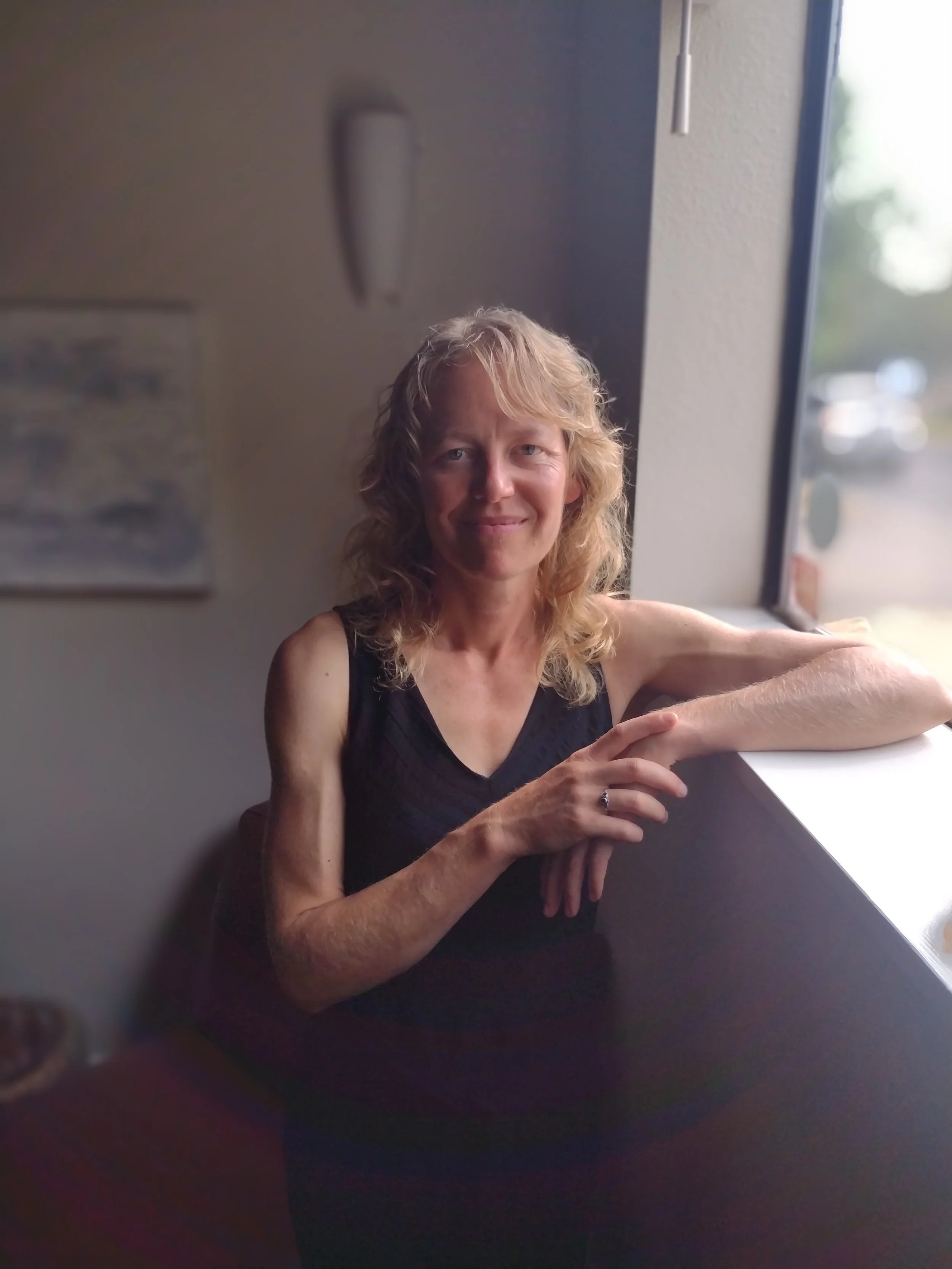
Movement is my first love. At five years old, my career goal was to become a dancer-teacher-nurse, and I refused to wear anything but a pink bodysuit and tutu.
Practice and Philosophy
Raised in a household that practiced the Japanese arts of Reiki and Aikido, I was imbued with eastern healing and martial principles from a young age. As a second generation reiki practitioner, I have wrestled with how to understand and incorporate this inheritance into my life and work. I was initiated in First Degree in 1989, at six years old, and took Second Degree from a dear family friend at 17 years old.
In 2012 I began an informal study of Chinese medicine while learning to cultivate Chinese medicinal herbs. I also discovered Qigong, a Chinese medical movement art designed to enhance vitality and self-healing, and began an ongoing study with Robert Bates of Bellingham, WA in 2015. Qigong (Chi Gong) encompasses a vast system of moving and meditative forms, traditionally passed down within specific regions and families in China. Along with its close relative, Taiji (Tai Chi), it has become more broadly accessible in the West in recent years.
In 2022 I was recommended to find Lindsey Wei, and became a student of the Wudang lineage of internal martial arts and Daoist meditation. I also relocated to the beautiful Willamette Valley of western Oregon. In the years since I have branched into contemporary somatic movement studies, including professional application training and mentorship with Liz Koch of CoreAwareness™. In 2024 I completed a ten-week apprenticeship in Resistance Flexibility and Strength Training (RFST) with Eric Dermond, lead trainer at The Genius of Flexibility studio in Boston, MA. I also hold a Stretching and Flexibility Coach certification from the National Academy of Sports Medicine (NASM). My interest in study, learning and practice doesn’t end.
The deeper modern science delves into the complexities of the body, the more these findings confirm understandings held within Chinese medicine for thousands of years. One of the primary differences between western and eastern medical traditions is reflected in whether the body is seen as a collection of parts or as a living system. What I have experienced and witnessed is that understanding ourselves as biological rather than mechanical changes the way we move through the world. Changing the way we move eventually shifts the condition and health of our tissue, the types and amount of pain we experience, and the possibilities we perceive.
More About What Came Before
Between my mid-twenties and thirties, I spent ten years in the fields of ornamental and restoration horticulture. My work as a native plant seed collector had me traversing five counties in northwest Washington and over the Cascade Crest. Following these plants through the seasons and across the landscape, I came to see flowering and maturation of seed as an expression of the movement of qi through ecosystems. This training developed a precision of attention and ability to sense timing and location that I now apply to my work with the body. Internal and external landscapes are equally varied in their expression, and the ability to successfully navigate the outside world is often dependent upon the clarity and vibrance of the inner one.
Growing up as a black sheep in the Silver Valley of northern Idaho (or North Idaho, if you’re local!), I learned a lot about how it felt to be disconnected. The economy there in the ‘80s had been devastated by the closure of the silver mines. No fish swam in the river. The banks were bare with strange-colored pools of water. Raised by liberal Reiki Masters amidst miners, loggers, and church-goers, the only thing about me that fit in was my skin color. What I learned from my upbringing is that what matters most is 1) humility and 2) being a good neighbor. We need each other. And we need the land. None of us have all the answers, but together we have many possibilities.
Acknowledgements
A big thank you to Scott Moss of Corvallis, OR for the latest portraits. Many thanks to David Campbell for the photo from my workshop. Appreciation also to a host of artists and photographers on Unsplash: Arthur Hutterer is also featured on the Walking Workshop page; Nathan Dumlo, Jan Wandelaar from the Europeana collection, and Jeremy Yap for the Private Sessions page images. Clayton Lee for the Book Now page image. Dimmis Vart, okeykat, and Miguel Garcia Jimenez for the Group Classes photos. Aaron Lee’s photograph on the Contact page. It is a gift to be able to freely use your work.
Gratitude to the original inhabitants of the Willamette Valley, Klamath, Cascades, and coastal ecoregions: the indigenous nations and native species. May these lands and waters be restored for your benefit.
Thank you.